
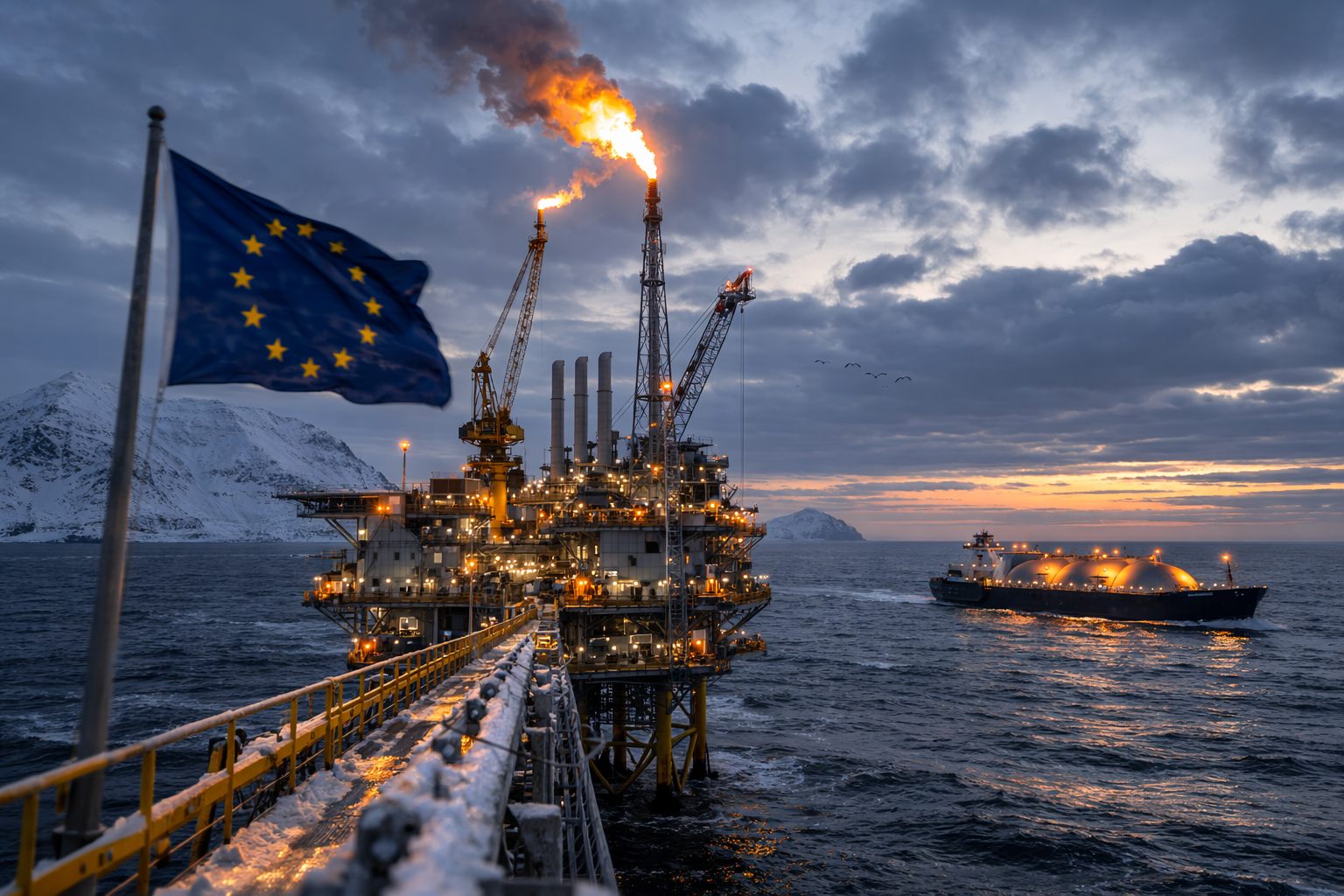
Norway’s Barents Sea gas could remain a vital energy source for Europe well into the 2030s, offering a nearby, lower-emission alternative to the increasingly volatile global liquefied natural gas (LNG) market, provided the European Union rethinks its Arctic policy, according to an analysis from Rystad Energy.
The European Commission has been reviewing its 2021 Arctic policy and has initiated a public consultation, which is open until March 16.
Given that Barents projects generally require five to ten years to transition from initial discovery to consistent production, the direction the EU sets now is critical.
This decision will determine whether new volumes from existing Norwegian fields will be ready by the mid-2030s, or if Europe will instead become more dependent on global LNG supplies over the next decade.
EU’s critical Arctic policy review
According to Rystad Energy’s analysis, the EU has the potential to increase production in the Barents Sea.
This could be achieved by establishing a more defined boundary, both geographically and operationally, without needing to compromise its current climate position.
“Lead times in the Barents Sea are long, so clear policies matter,” Tore Guldbrandsøy, Partner and Oil & Gas Analyst at Rystad Energy, said in a statement.
“If the EU sets clear definitions and requires data-backed verification, it can keep near-term supply options open without blurring its climate standards.”
The EU could differentiate its “Arctic” policy by applying a narrower definition and linking eligibility to strict environmental and emissions criteria.
This approach would prevent the bloc from grouping Norway’s existing Barents Sea acreage with unexplored, frontier areas.
While this distinction would likely still face opposition from environmental organizations and wouldn’t resolve the core debates surrounding Arctic drilling, it might influence how both buyers and policymakers assess future supply choices throughout the 2030s.
Differentiated Arctic policy proposal
Under Rystad Energy’s base case projection for the EU27, UK, and Norway, Norwegian gas is expected to fulfill approximately 20-30% of gas demand until 2050.
Concurrently, the share of LNG is anticipated to increase significantly, rising from 30% to 50% over the same timeframe, which will consequently heighten Europe’s reliance on international markets.
While the resource base in the Barents Sea is significant, converting it into a reliable supply presents challenges.
The Norwegian Offshore Directorate estimates that the areas currently open for exploration in the Barents Sea contain approximately 3.5 billion barrels of oil equivalent (boe) of natural gas, or about 22 trillion cubic feet.
However, Rystad Energy forecasts that production from existing fields and those expected to be approved by 2030 will yield a combined output of around 2.25 billion boe through 2050.
Any production exceeding this projection will likely depend on several critical factors: new discoveries, the coordinated development of multiple fields, and, most importantly, the availability of export capacity.
Production forecasts and infrastructure hurdles
The scalability of long-term development in the region is significantly dependent on infrastructure.
Currently, the primary export route is Hammerfest LNG in the far north, but its capacity is mostly constrained by the Snøhvit field, making it difficult to accommodate new gas volumes.
A 2023 study by Gassco and the Norwegian Offshore Directorate indicated that establishing new Barents export capacity could be socio-economically beneficial, provided that sufficient gas reserves are confirmed.
One viable option is a pipeline linking south into the Norwegian Sea network; however, the financing of such a project would require adequate scale and the synchronization of timelines across various development projects.
Policymakers are currently focused on emissions during the review period, a factor that will directly influence how purchasers assess and compare future Barents gas against alternative supplies.
Norway’s upstream production is already among the lowest-emitting globally, positioning gas delivered via pipeline from Norway as a generally lower-emissions choice for Europe.
Emissions as key policy differentiator
The Snøhvit project already reinjects captured carbon dioxide (CO₂) offshore, and its carbon footprint is anticipated to decrease even further with the planned electrification of the Snøhvit–Hammerfest LNG facilities.
While environmental critics point out that even lower emissions intensity from burning gas still contributes carbon dioxide to the atmosphere, methane leakage and overall carbon intensity are becoming key factors in policy and procurement decisions.
These metrics are increasingly used to differentiate between remaining supply sources as the energy transition progresses.
“Opening the door completely is not a realistic option for the EU, but a well-structured framework with tight definitions and standards could keep sensitive northern Barents areas off-limits, while explicitly distinguishing already-open Norwegian zones from frontier areas,” Rystad Energy said in the analysis.
Europe will prioritise comparisons of existing marginal gas supplies rather than adding significant new volumes, Emil Varré Sandøy, vice president for oil & gas research at Rystad Energy, said.
While employing lifecycle emissions and methane performance as selection criteria won’t resolve the broader climate discussion, it will direct the remaining gas demand toward options with a lower environmental impact, according to Varré .
“A clearly defined and structured Arctic policy can help move the EU in that direction.”
The post EU Arctic shift could unleash Norway gas for Europe’s 2030s appeared first on Invezz