
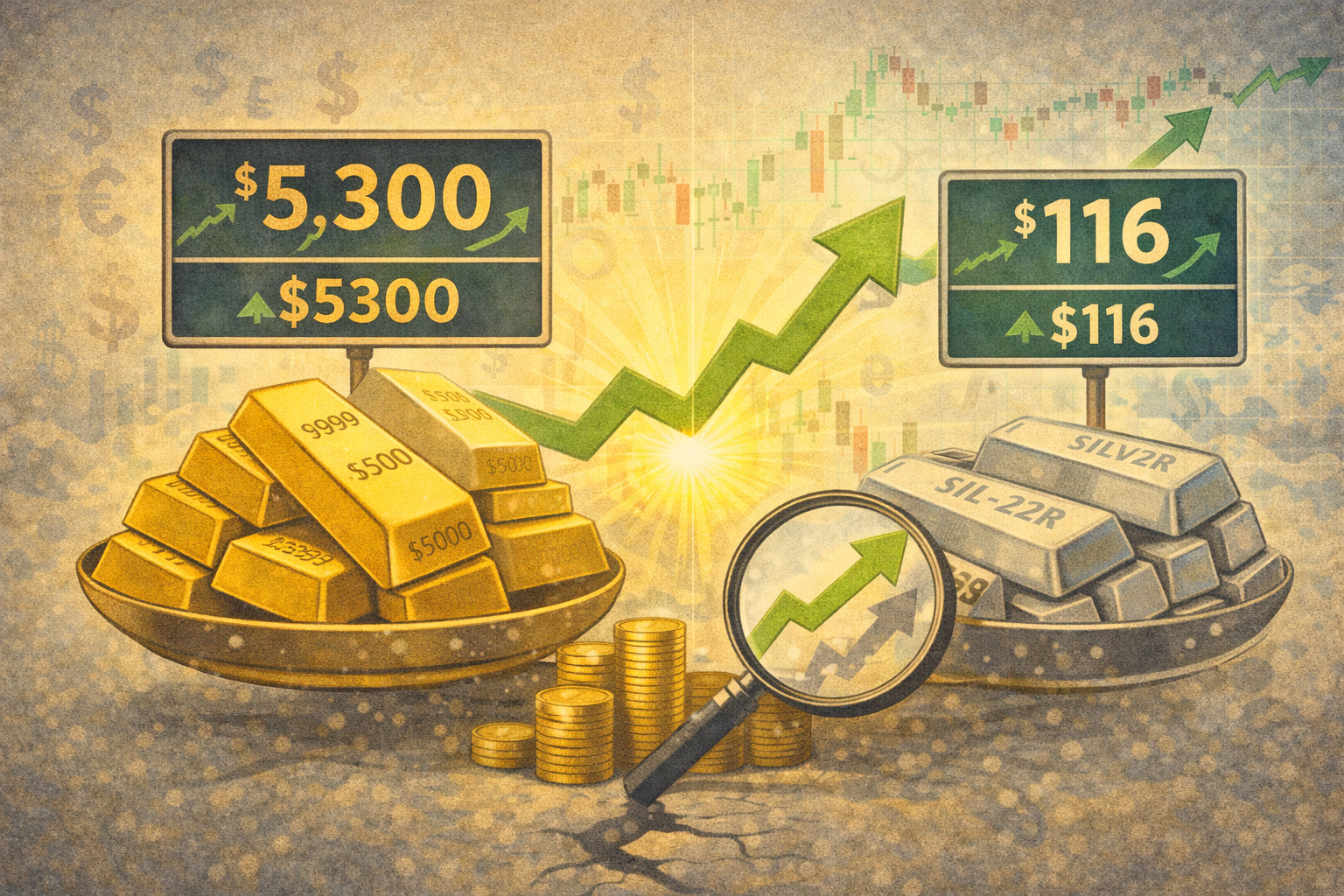
Gold’s blistering run is likely to continue as prices breached the $5,200 per ounce mark on Wednesday for the first time in history.
Meanwhile, silver prices on COMEX also climbed above $116 per ounce for the first time earlier on Wednesday as the white metal continued its record-shattering run.
Experts believe that both metals have more room for upside due to gold’s safe-haven appeal and silver’s industrial demand.
On Wednesday, gold prices rose sharply over 3% as the dollar fell to a near four-year low amid geopolitical tensions.
At the time of writing, gold prices on COMEX were at $5,294.35 per ounce, up 3.4%, while silver was at $115.480 per ounce.
Gold had touched a record high of $5,297.86, and is looking to breach the $5,300 level.
Market forces driving gold and silver’s ascent
A decision by the US Federal Reserve on monetary policy is also awaited later on Wednesday.
The US dollar faced a “crisis of confidence,” selling off sharply and hovering near four-year lows.
The decline was amplified after US President Donald Trump, when questioned about the dollar’s possibly excessive decline, responded by calling the currency’s value “great.”
Amid growing concerns about a weak job market and elevated prices, US consumer confidence dropped to its lowest point in over 11-1/2 years in January.
Meanwhile, Trump said he will soon announce the new head of the US central bank, predicting that interest rates would decrease following the new chair’s appointment.
The Federal Reserve is widely anticipated to keep rates unchanged at its ongoing January monetary policy meeting, which is scheduled to conclude later on Wednesday.
“Even though short-term pullbacks may happen, gold continues its upward trend. Investors who entered the market this year are very likely to see it reach new highs and approach $5,500 in the near future,” Alex Tsepaev, chief strategy officer of B2PRIME Group, said.
The present moment is characterised by extreme unpredictability and rapid change.
Concurrently, the market is experiencing an accelerated trend toward de-dollarisation, sustained demand from developing nations, and ongoing global monetary expansion, Tsepaev said.
There is also the issue of US debt sustainability and growing geopolitical tensions, such as new tariffs or the purchase of Greenland.
Add to that the pressure on the Fed, and we have support for interest in gold as a safe-haven asset.
Gold as safe-haven vs. silver’s industrial link
Gold is expected to remain the favored alternative safe-haven asset.
Its strong preference stems from its long-established role as a store of value and its institutional independence.
“This means that it is not exposed to counterparty risk. The same applies in principle to silver, which is why it has recently risen significantly in the wake of gold,” Thu Lan Nguyen, head of FX and commodity research at Commerzbank AG, said in a report.
Unlike gold, however, silver has not traditionally served as a safe haven, which is why the price increase could be on shakier ground.
The demand for silver, unlike gold, experiences stronger fluctuations tied to economic conditions because of the white precious metal’s high industrial use.
The near-quadrupling of silver’s price since the start of 2025 is expected to negatively impact industrial demand for the metal, according to Nguyen.
On the other hand, however, the physical silver market has been quite tight in recent years.
Ultimately, the continuation of the precious metals market rally will hinge on geopolitical developments.
Geopolitics and monetary policy
A significant market correction, characterised by a broad price decline, could be triggered by a shift in global geopolitical dynamics.
Commerzbank has listed four such scenarios, which include the following;
Specifically, a credible de-escalation or end to major ongoing conflicts, such as the war in Ukraine, followed by the lifting of related Western sanctions against Russia, would remove a key source of current market uncertainty and volatility, Nguyen noted.
This move towards stability could prompt a re-evaluation of risk premiums and economic forecasts, potentially leading to a sharp market adjustment, she added.
Furthermore, a return to greater global cooperation and multilateralism could also act as a catalyst for a correction.
This would involve the reversal of current trade barriers, particularly the reduction or removal of US tariffs, and a renewed, clear commitment to established international agreements concerning both trade and security.
Alongside this, governments globally would need to adopt and implement credible fiscal consolidation measures aimed at stabilizing or significantly reducing high levels of public debt.
These combined factors would signal a fundamental change in the long-term risk and reward calculation for investors.
Finally, the independence and action of the US Federal Reserve are paramount.
A market correction could occur if the US Federal Reserve resists political pressure, such as from Trump, to implement significantly lower interest rates.
Maintaining a policy stance based on economic fundamentals, rather than political expediency, could lead to tighter monetary conditions than the market is currently pricing in, thus triggering a downward move in asset prices.
“Given the high level of uncertainty regarding further political developments and the current dynamics, it is virtually impossible to make a reliable price forecast,” Nguyen said.
We see room for further price increases, primarily due to our expectation of a significantly more expansionary US monetary policy.
The post Precious metals rally continues with gold nearing $5,300, silver topping $116 appeared first on Invezz