
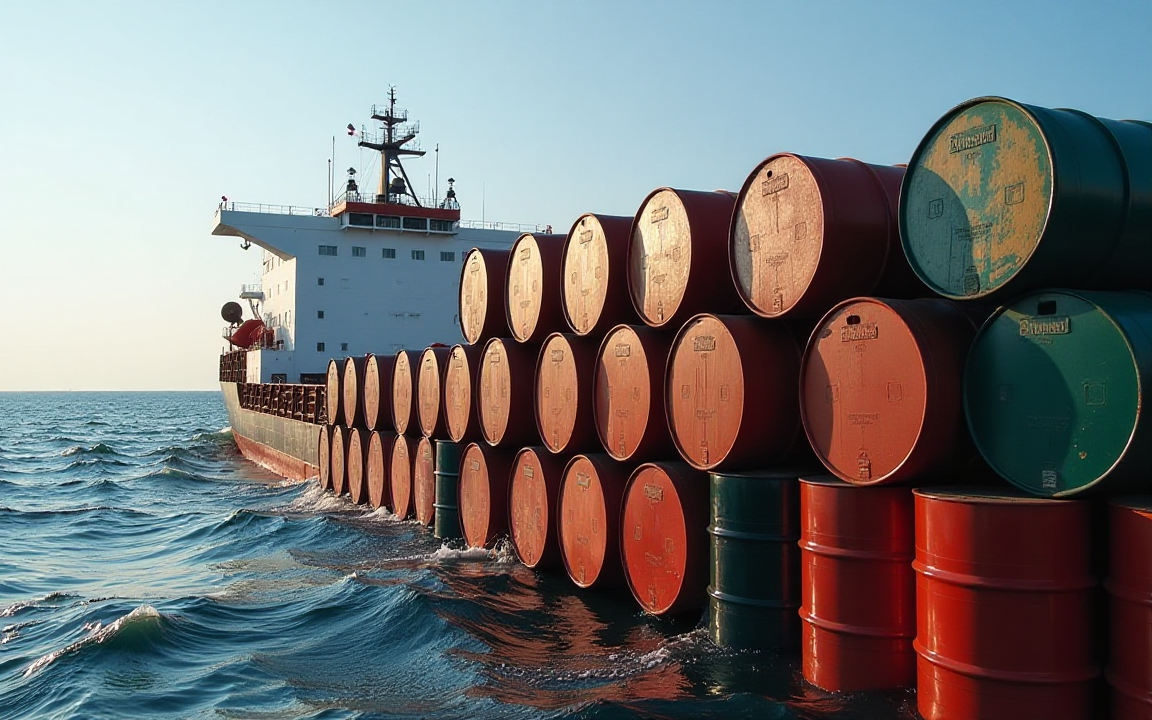
Escalating military tensions between the US and Venezuela are poised to significantly impact benchmark crude oil prices, as the Trump administration intensifies pressure on Nicolas Maduro’s regime and hints at the possibility of a US incursion.
“The loss of Venezuelan volumes would likely result in stronger crude oil prices in the Pacific Basin, with China and India dependent on the heavy supply,” Jorge Leon, head of geopolitical analysis at Rystad Energy, said in an emailed commentary.
Dubai prices are likely to develop stronger premiums to Brent crude while other heavy grades will strengthen against the light grades.
The expected decrease in Venezuelan oil supply is also anticipated to result in an increase in the prices of both Brent and West Texas Intermediate (WTI) crude, he added.
Venezuela’s production profile and decline
Venezuela’s current crude oil output of 1.1 million barrels per day (bpd) is at risk due to potential US military escalation, according to Rystad Energy’s estimates.
While this volume is not globally significant, its composition is notable, with heavy crude accounting for over 67% of the production.
Reports indicated that the Trinidad and Tobago government has backed the establishment of a radar station for US operations at the Tobago airport, signalling an increase in American military activity in close proximity to Venezuela.
As of 2024, Venezuela reports possessing the world’s largest proven oil reserves, estimated at approximately 300 billion barrels.
These reserves are predominantly heavy oil and are concentrated in the Orinoco belt.
Significant historical investment in Venezuela, primarily from countries like China, Russia, Iran, and the US, was initially spurred by large discovered and proven reserves.
However, despite these large reserves, production has been steadily declining since the early 2010s due to persistent technical problems and a lack of sufficient investment.
Venezuela’s oil production, once peaking at nearly 3 million bpd, significantly declined following governmental changes and the nationalisation of assets, hitting a low of 624,000 bpd in 2020.
This drop in output is compounded by the fact that most of the country’s domestic refining capacity is non-operational due to disrepair.
Despite these domestic issues, PDVSA (The Petróleos de Venezuela, S.A) retains international refining interests.
Specifically, its majority-owned subsidiary, CITGO, operates three refineries in the US (in Lake Charles, Louisiana; Corpus Christi, Texas; and Lemont, Illinois) and holds subsidiary interests in refineries across the Caribbean and Europe.
In 2024, Venezuela’s crude oil production reached 975,000 bpd, according to Rystad Energy.
Of this total, heavy crude accounted for 657,000 bpd, while light and medium crude production averaged 116,000 bpd and 201,000 bpd, respectively.
While Venezuela’s production represented only about 1% of the global supply in 2024, it constituted a more significant 4.5% of the global heavy crude oil supply, the Norway-based energy intelligence company said.
Sanctions, export shifts and volatility
This year is projected to be a peak production year, with output estimated to hit 1.11 million bpd.
Following this peak, production is anticipated to enter a period of slow decline, dropping to 901,000 bpd by the end of 2030.
Historically, the vast majority of these exports went to the US, China, Spain, or India, with a relatively even distribution among these four countries before 2020.
However, by 2025, US sanctions had significantly altered this pattern, redirecting exports primarily to China, which accounted for 81% of Venezuelan exports in the third quarter of 2025, Rystad said.
Even though the US has largely ceased importing Venezuelan oil, the overall constraint on the global heavy crude market will drive up prices for heavy grades the US relies on, according to Rystad Energy.
Specifically, this includes Canadian heavy crude oils transported to Pacific markets via the Trans Mountain Pipeline and to US markets through various other pipeline networks.
Dubai crude has become a key benchmark for the Pacific Basin’s crude oil market.
Its price has recently been trading higher than the Intercontinental Exchange (ICE) Brent due to a confluence of factors: the OPEC+ production cuts implemented in 2024, and the increased difficulty in sourcing illicit Russian crude following deeper sanctions.
Volatility in the region is expected to continue in the near term. The geopolitical risk premium is firmly entrenched in oil markets, meaning upside price risks remain, as traders anticipate potential setbacks or renewed escalation, Leon said.
Over the coming days and weeks, the balance between cautious optimism and entrenched uncertainty will continue to shape market sentiment.
The post Geopolitical oil shock: US-Venezuela tensions threaten heavy crude prices appeared first on Invezz