
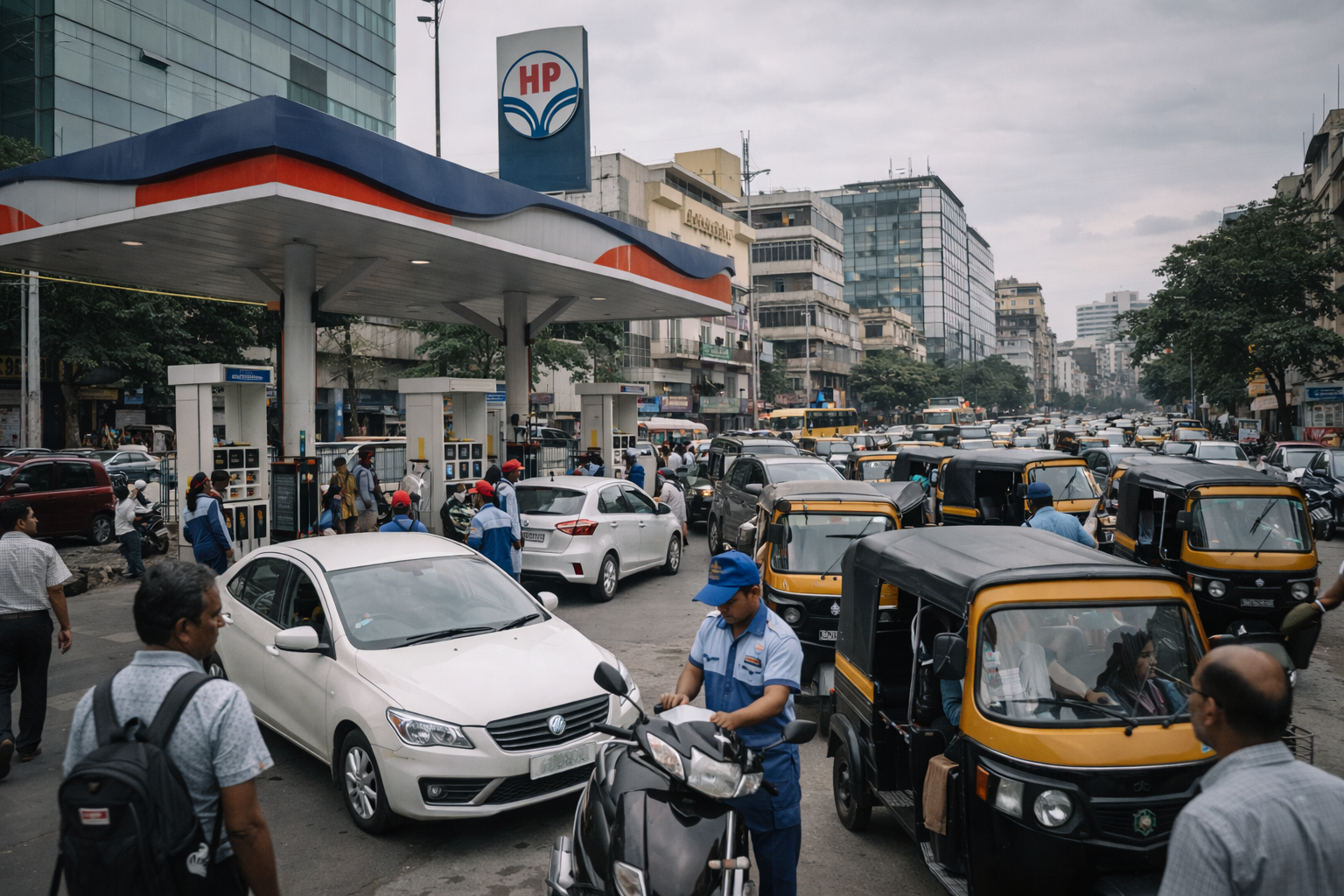
Indian refiner stocks tumbled on Monday as escalating tensions from the widening US-Israeli war with Iran pushed Brent crude prices toward a four-year high of $120 per barrel, raising concerns about the refiners’ immediate profit outlook.
Shares of state-run Indian Oil, Hindustan Petroleum Corporation Ltd, and Bharat Petroleum Corporation Ltd experienced significant drops.
Indian Oil dipped 6.6%, HPCL slid 7.5%, and BPCL dropped 7.1%.
These declines set them on track for their sharpest falls in over a year.
Brent crude oil prices surged dramatically, peaking at $119.46 a barrel with a 26% gain, and were last trading up 25% at $115.32.
Similarly, the price of West Texas Intermediate crude oil surged to a high of $119.43 per barrel, and was last trading at $113.35 a barrel, up 24.7%.
Both benchmarks touched their highest levels since the start of the Russia-Ukraine war in 2022.
Brent hit the triple-digit figure for the first time since August 2022.
Market downgrades and index slump
The sharp rise in crude is expected to negatively impact oil marketing companies (OMCs) like IOC, BPCL, and HPCL, according to UBS.
This is because these companies are “negatively leveraged” to the spike, as their sales of diesel and gasoline significantly exceed their production.
UBS estimates the sales-to-production ratios for IOC and BPCL at 1:2 and for HPCL at 2:2, according to a Reuters report.
The brokerage firm downgraded its ratings on several oil companies, leading to a significant market slump.
It cut Indian Oil Corporation (IOC) and BPCL to “neutral,” and changed its rating on HPCL from “buy” to “sell.”
This action caused a steep decline in related indices.
The Nifty oil and gas index fell by 3.0%, and the energy index dropped 2.6% at the time of writing. In comparison, the benchmark Nifty 50 slid 2.8%.
Since the US-Israeli strike on Iran on February 27, the oil and gas index has seen a 6.6% drop.
Citi has issued a warning regarding the vulnerability of refiners’ earnings, emphasising that their performance will largely depend on the duration of the current geopolitical instability.
Geopolitical vulnerabilities and supply outlook
The banking giant highlighted significant risks, particularly the potential closure of the Strait of Hormuz and any halt in Qatar’s LNG production.
These two sources are crucial, supplying approximately half of India’s total crude and LNG imports.
Furthermore, Citi cautioned that any disruption extending beyond the one month currently factored into prices could severely constrain the LNG markets.
The brokerage pointed to low European storage levels anticipated for October 2026, which significantly increases the danger of sudden and dramatic, or “non-linear,” price increases.
“Even if flows through the Strait of Hormuz start to resume, it will take time for upstream production to ramp up,” Warren Patterson, head of commodities strategy at ING Group, said in a note.
“The combination of these production shut-ins and no signs of de-escalation in the war means the market is having to aggressively price in a prolonged supply disruption.”
Oil prices are set to increase further unless oil shipments resume through the Strait of Hormuz.
Despite crude oil trading above $100 per barrel and supplies tightening, neither the International Energy Agency (IEA) nor the European Union has yet recommended tapping government oil reserves.
The IEA stated that there are no current plans for a coordinated release.
The EU, similarly, advised member states that such action is not immediately necessary.
However, with Middle East developments impacting the market, reports last week indicated that the Japanese government is considering utilising its reserves, suggesting that pressure for reserve releases is likely to intensify.
The post Indian refiners feel the pain as crude oil smashes past $100/barrel appeared first on Invezz