
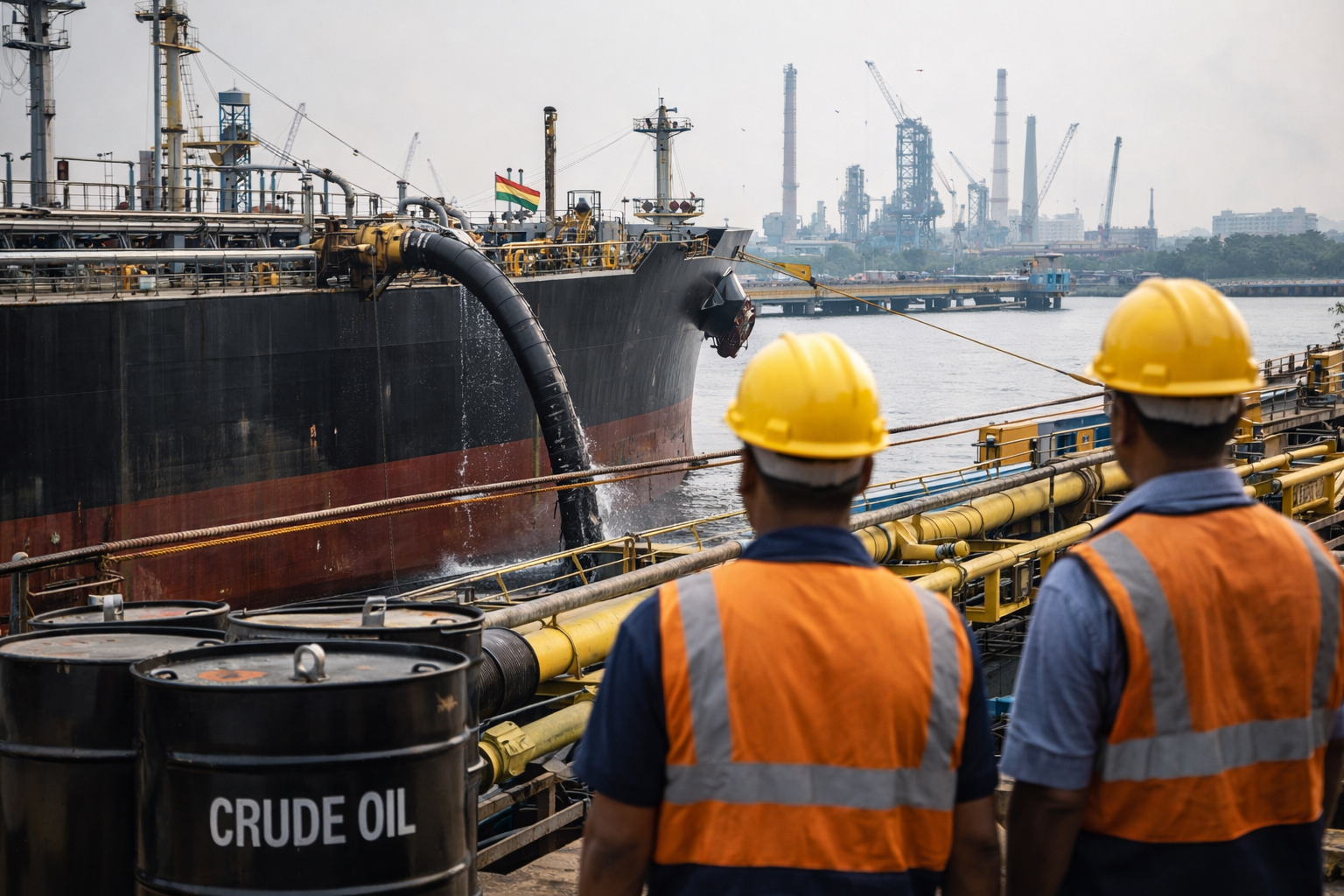
Shares dropped and oil prices dramatically increased on Monday as the protracted military conflict in the Middle East threatened a global economic recovery and could potentially trigger renewed inflation.
Oil markets opened substantially stronger this morning, an unsurprising development, with ICE Brent initially soaring by up to 13% to trade over $82 per barrel.
Brent prices last traded at $78 per barrel, up 7%, while West Texas Intermediate crude was 6.7% higher at $71.50 per barrel.
“Perhaps more surprising is that the market has given back some of these gains, trading just 6% higher at the time of writing,” Warren Patterson, head of commodities strategy at ING Group, said in a note.
Shares of downstream oil marketing companies (OMCs) in India dropped sharply on Monday as crude prices shot up.
Downstream OMCs bear the brunt
Downstream companies such as Hindustan Petroleum Corporation Ltd, Bharat Petroleum Corporation Ltd and Indian Oil were all deeply into bear territory this morning.
The recent surge in global crude oil prices presents a significant and immediate challenge for oil marketing companies (OMCs).
As the primary raw material for refined petroleum products, the rising cost of crude directly inflates the OMCs’ procurement expenses.
This increase in the cost of goods sold exerts intense downward pressure on their operating margins.
OMCs typically operate with a time lag in passing on the full increase in input costs to consumers, especially in regulated or politically sensitive markets.
This delay compresses their profitability in the short term, leading to inventory losses as the cost of replenishing stock is higher than the price at which the existing inventory was sold.
Furthermore, sustained high crude prices necessitate increased working capital to finance the more expensive crude imports and maintain inventory levels, thereby straining the companies’ financial health and liquidity.
The ability of OMCs to manage this challenge hinges on efficient inventory management, strategic hedging, and the timely adjustment of retail fuel prices in line with international crude benchmarks.
At the time of writing, shares of BPCL were down 2.4% at 376.15 INR, while Indian Oil Corp was at 180.65 INR, down 3.7%. HPCL shares slipped 1.4%.
Upstream companies gain
Meanwhile, the conflict with Iran is expected to provide a short-term lift to certain oil stocks.
Upstream oil companies such as Oil and Natural Gas Corporation Ltd and Oil India gained earlier in the day.
Higher crude prices, triggered by geopolitical instability in the Middle East and fears of supply interruptions, have fueled a rally in these stocks.
Companies involved in the exploration and production of crude oil, like ONGC and Oil India, usually see a positive impact from rising oil prices.
When global crude rates rise, upstream oil companies can charge more for their products, which directly boosts revenue and profit margins, assuming their production costs do not increase significantly.
ONGC shares initially saw a sharp 5% increase in early trade, hitting a 52-week high of 293 INR, up from the previous close of 279.70 INR.
However, the stock later pared some of the gains and was trading 1% higher at 282.90 INR.
Oil India shares had gained 4% earlier in the day to trade above 500 INR, and were up 0.3% at the time of writing.
Meanwhile, Probal Sen, an energy analyst at ICICI Securities said crude oil prices around $75 per barrel are unlikely to lead to windfall taxes, according to a CNBCTV18 report.
This scenario is favorable for upstream companies like ONGC and Oil India.
Conversely, Sen anticipates short-term difficulties for downstream and gas companies, as rising costs associated with liquified natural gas (LNG) could negatively affect their profit margins, according to the report.
Uncertainty over Strait of Hormuz
With military strikes from the United States and Israel continuing against Iran, the situation showed no signs of de-escalation.
In response, Iran launched missile barrages across the region, raising the risk of drawing neighbouring countries into the conflict over the weekend.
US President Donald Trump indicated to the Daily Mail that the conflict might persist for another four weeks, while simultaneously stating on a social media post that attacks would continue until US objectives were achieved.
The world’s attention is focused on the Strait of Hormuz, a crucial transit point for approximately a fifth of global seaborne oil and 20% of liquefied natural gas trade.
Although the essential waterway remains open, maritime tracking data indicates a buildup of tankers on both sides of the strait.
This congestion suggests vessels are hesitant to proceed due to fear of attack or difficulty securing necessary voyage insurance.
“If the Strait of Hormuz were to close, the most likely scenario is that it would be temporary, potentially lasting one to two weeks,” Rystad Energy said in an update.
The effect on oil and gas flows is largely identical, whether the Strait is forcibly shut or becomes unusable due to risk aversion.
Should the disruption of the Strait be prolonged, nations possessing strategic petroleum reserves might intervene by releasing stored volumes, Rystad Energy said.
“Unless de-escalation signals emerge swiftly, we expect a significant upward repricing of oil at the start of the week.”
The post Mideast conflict lifts Brent 7%; Indian OMC stocks tumble appeared first on Invezz