
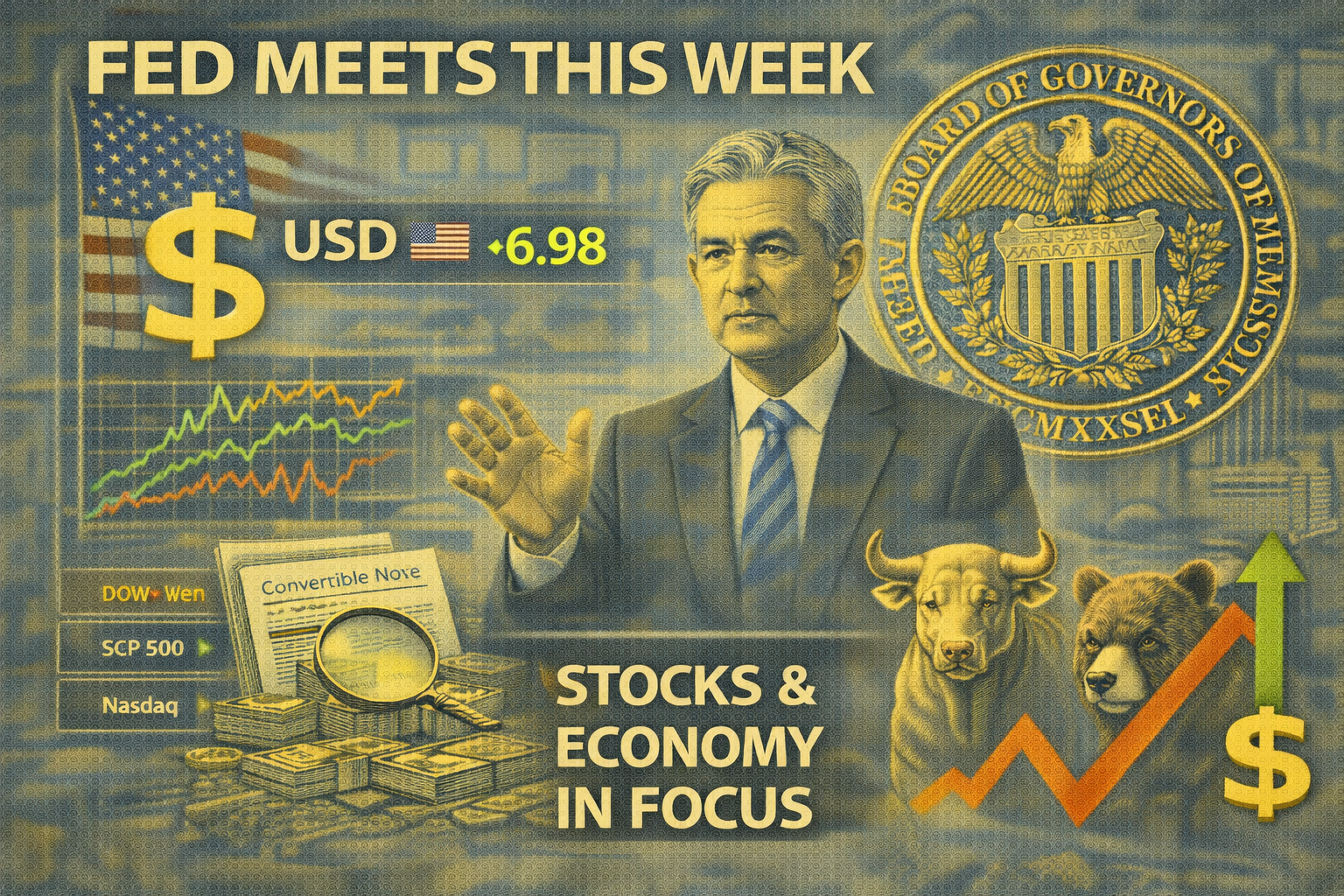
Investors head into this week’s Federal Reserve meeting expecting no change in interest rates and an uneventful outcome, while market leadership continues to widen beyond mega-cap tech.
According to CME FedWatch, markets assign a 97% chance the Fed holds steady when the Federal Open Market Committee concludes on Wednesday afternoon.
Rates markets were calm, and the dollar softened, with the USD at a four-month low and the yen firmer amid intervention risks, according to the Global Strategy Team at TD Securities.
US stock futures were mixed early Monday: Dow futures were less than 0.1% higher, S&P 500 futures were mostly flat, and Nasdaq 100 futures were roughly 0.1% lower.
What to expect from the Fed this week
The Fed meets Tuesday and Wednesday, with a decision due Wednesday afternoon. TD Securities expects “a relatively uneventful meeting,” with the central bank remaining on hold.
Alex Guiliano, chief investment officer at Resonate Wealth Partners, also expects an uneventful Jan. 28 meeting and “little reason for the Fed to cut rates right now, especially after cuts at each of the last three meetings,” he told MarketWatch.
The current rate-cutting cycle began in September 2024.
Political pressure on Chair Jerome Powell has intensified.
According to MarketWatch, President Donald Trump has pushed for lower rates, attempted to fire Fed governor Lisa Cook, and opened a criminal investigation into Powell.
Guiliano said he expects Powell to tread carefully if the topic arises in the press conference.
Markets focus on earnings and the economy
Despite the Fed backdrop, investors appear more focused on earnings and the economic outlook.
“I don’t think the market needs a cut,” and it can be fine without one early this year, Liz Thomas, head of investment strategy at SoFi, told MarketWatch.
Market leadership has broadened. Growth sectors, including tech, have lagged more cyclical and value areas in recent months.
Energy, industrials, and materials have been early 2026 winners, and the small-cap Russell 2000 has outpaced the S&P 500 in January, according to MarketWatch.
MarketWatch notes the US economy looks stable, with inflation largely under control and GDP growth solid.
A return of federal data releases after last fall’s shutdown has helped investors assess trends following a soft patch in the 2025 labor market.
Currency and rates backdrop
TD Securities reported a quiet session for Treasuries, with rates finding support.
Data were limited: the S&P Composite PMI for January ticked up to 52.8 from 52.7, while the University of Michigan index was revised to 56.4 from 54.0.
The USD hit a four-month low to start the week, while the JPY gained on intervention risks, with talk of coordinated rate checks from the Fed and Bank of Japan, TD Securities said.
Near-term catalysts to watch
Earnings could be the bigger swing factor. Half of the “Magnificent Seven” report this week, with Microsoft, Meta Platforms, and Tesla on Wednesday, Jan. 28, and Apple on Thursday, Jan. 29, according to MarketWatch.
These names still carry significant weight in the S&P 500, though broader participation could make the market more durable.
“The S&P 500 is expected to grow earnings by 15% this year and is currently priced around 22-times next year’s earnings,” Scott Helfstein, head of investment strategy at Global X, told MarketWatch.
He added that most of last year’s gains arrived during earnings season, suggesting fundamentals are a key driver, while lower rates are a tailwind but “not a precondition” for stocks to rise.
Policy outlook and politics
MarketWatch reports that Trump is expected to name a new Fed chair, which could bring “stock-market volatility” as the market adjusts midyear, according to Guiliano.
Traders are starting to price a 59.4% chance of a June rate cut, which may reinforce a pause at the next few meetings.
Why Fed days still move markets
Even if the Fed stands pat, volatility around the press conference remains common.
Thomas said investors often “listen so closely and hang on to every word of Jerome Powell,” and warned that “the most dangerous time to trade is between 2 and 2:30 p.m. Eastern time on Fed days.”
Bottom line: with the Fed widely expected to hold, attention is shifting to earnings and the economy, while FX and rates signal a calmer backdrop.
The next leg likely hinges on profit trends, incoming data, and the Fed’s leadership transition later this year.
The post Fed week: rates steady as investors shift focus to earnings and economic outlook appeared first on Invezz