
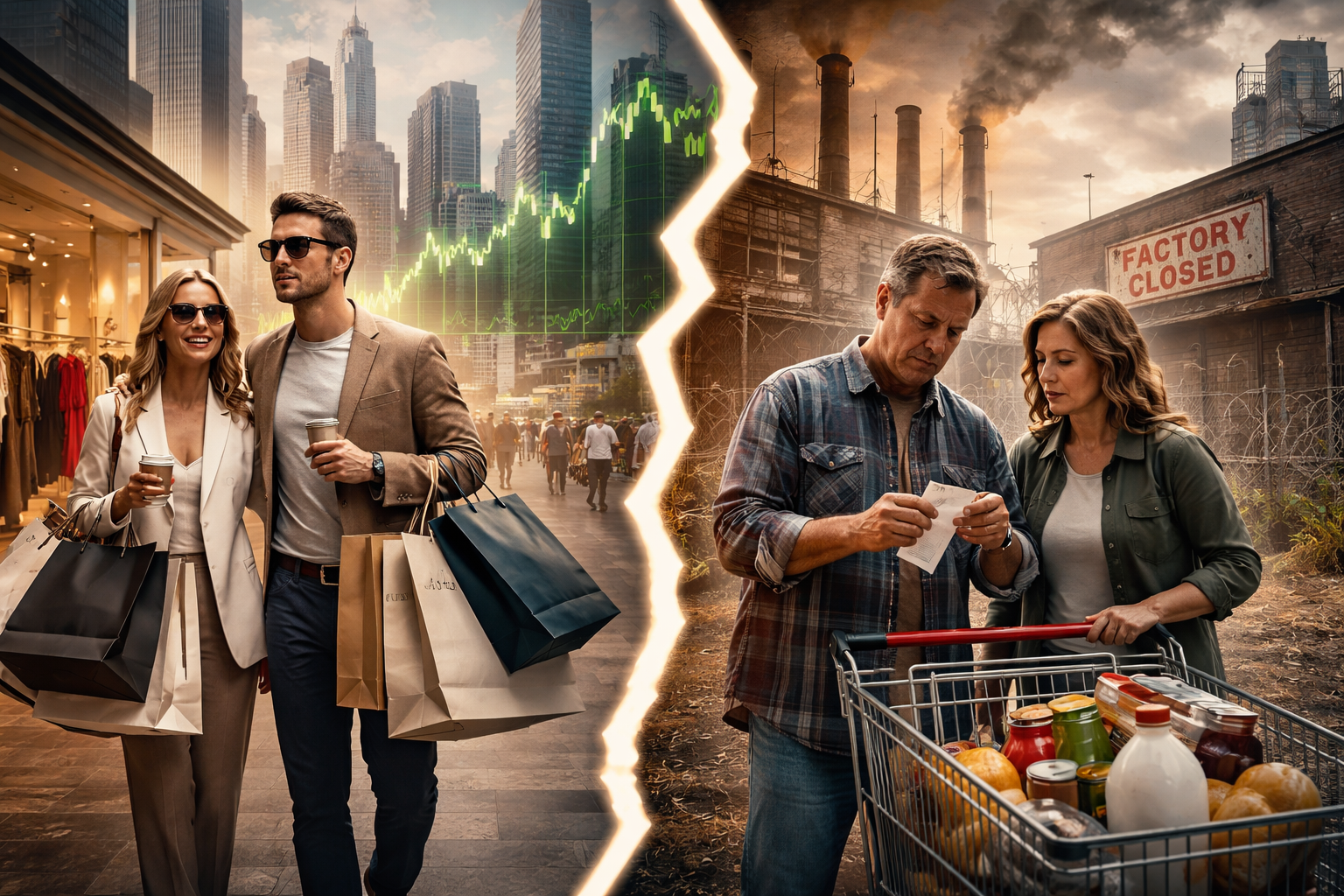
The United States just posted its strongest burst of economic growth in two years. Output surged, consumers spent freely, and the headline numbers looked solid.
But why do most Americans still feel that the economy is broken?
Fairness has always been central to how the American economy functions. So if fairness is truly gone, does it matter if the economy is growing rapidly?
Growth is strong but narrow
Official figures reported this week showed GDP growing at a 4.3% annual rate in the third quarter, according to the Commerce Department. That was well above forecasts and faster than the previous quarter.
The engine of growth was consumer spending, especially on services like healthcare, travel and professional services. Spending rose at a 3.5% pace. Inflation-adjusted income, however, was flat.
Core inflation picked up to 2.9%, still above the target of the Federal Reserve.
Business investment told a different story. Overall investment slowed sharply from earlier in the year.
Spending on factories and offices fell. Housing investment dropped for a second straight quarter. Trade added to growth mainly because imports declined, a statistical boost rather than a sign of domestic strength.
The objective story is that the economy is indeed expanding, but the sources of that growth are narrow.
It relies heavily on consumption rather than rising incomes or productive investment. That matters for how growth is felt across society.
Who is doing the spending
Consumer spending now depends more on high-income households than at any point in recent history.
Data from Moody’s Analytics show the top 10% of earners account for about half of all consumer spending, and the top 20% drive nearly two-thirds.
Before the pandemic, the bottom 80% made up around 42% of spending. That share has fallen to roughly 37%.
This situation explains why the economy can grow fast while many households feel stuck. Asset owners benefit from higher stock prices and rising home values.
Those gains support spending even when wages lag. Lower and middle-income households rely more on paychecks.
Their real incomes have barely kept up with prices for essentials like food, rent, and energy.
The uneven spending pattern shows up clearly at the local level. In wealthy areas, luxury sales are strong, and home prices keep rising.
A short drive away, food pantries report record demand.
Policy and the widening gap
Policy choices have reinforced these trends. Since President Donald Trump returned to office, economic growth has averaged about 2.5% a year, similar to the pace under the previous administration.
The distribution has changed. A major tax and spending package passed this year delivered large tax cuts to high earners while reducing federal support for programs like Medicaid and food assistance.
According to estimates from the Congressional Budget Office, households in the bottom income decile lose around $1,600 a year from the changes.
Those in the top 10% gain roughly $12,000. The law did not create the K-shaped economy, but it sharpened it.
Supporters argue that the focus on growth and incentives will pay off over time.
Critics point to rising hardship among working families and the strain on local charities. Both sides are partly right.
The economy can grow while inequality widens. The tension lies in how long that combination can last without political or social backlash.
When fairness meets incentives
The debate over fairness now sits at the center of economic discussion.
One camp argues that trying to engineer fairness too aggressively harms performance. Differences in outcomes reflect effort, skill, risk, and luck.
Attempts to level results weaken incentives and lower standards. Growth suffers. Trust erodes when institutions promise equality they cannot deliver.
The opposing view starts from a different place. What matters most is whether people believe the system treats them fairly as individuals.
Even if average outcomes look stable, perceived discrimination can destroy trust.
Laws against discrimination exist, but they are hard to enforce. When enforcement is weak or uneven, people conclude the system is rigged. They respond by retreating into identity politics or rejecting institutions altogether.
Both arguments capture something real. Incentives matter for growth. Perceptions matter for legitimacy. The mistake is to treat them as substitutes.
An economy that grows fast but feels unfair loses consent. A system that enforces fairness without regard to performance loses dynamism.
The real fault line
The most important divide in the US economy today is not simply between rich and poor. It is between measured growth and lived experience.
GDP is rising. Investment in new capacity is slowing. Consumption is strong at the top and fragile below. Real incomes are flat. Inflation remains high.
This combination produces a fragile equilibrium. As long as asset prices hold up, high-income spending can carry the economy.
A moderate market downturn could reverse that quickly. With the bottom 80 percent already stretched, there is little buffer.
At the same time, institutional trust is under pressure. When people see strong growth but feel no improvement in their own finances, they look for explanations. Some blame unfair policies. Others blame discrimination or favoritism.
Both narratives gain traction when growth feels exclusive.
Nobody is worried about the growth of the US economy. The risk lies elsewhere.
Growth that depends on a narrow slice of households and leaves most people unconvinced it plays by fair rules becomes harder to sustain.
The data shows strength. The distribution shows strain. The politics show the gap between the two.
The post US growth is booming, so why do most Americans still feel the pinch? appeared first on Invezz