
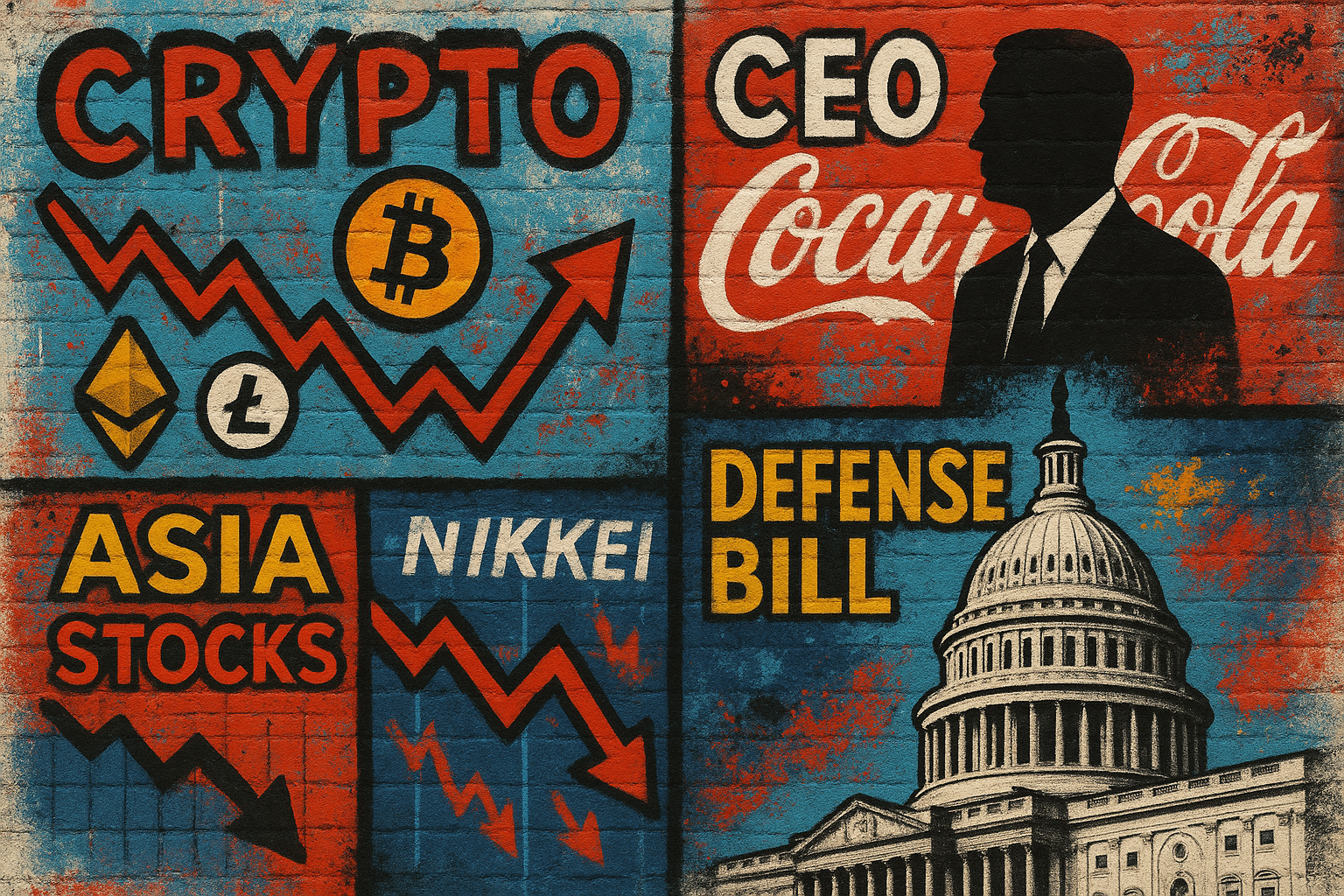
Global markets opened to a mix of risk aversion and corporate developments on Thursday as cryptocurrencies slid following renewed concerns around Federal Reserve guidance, while Coca-Cola announced a major leadership transition.
Asia’s equity markets also pulled back after disappointing results from Oracle, and US lawmakers advanced a $900 billion defense policy bill.
Crypto market slumps as fed outlook weighs on risk appetite
Bitcoin and major altcoins faced sharp declines on December 11 as investors reassessed expectations around the US Federal Reserve’s policy path.
Bitcoin was trading near $90,000, reversing gains made earlier in the week.
The CoinMarketCap 20 Index dropped 2.8%, while the total crypto market value slid 2.54% to roughly $3.08 trillion.
Altcoins mirrored the broader pullback. XRP fell 3.77% in 24 hours and 7.82% over the past week, while Solana, Dogecoin, Cardano, and Chainlink were all down more than 5% during the day.
The drop came as investors reacted to the Fed’s decision to lower rates and resume quantitative easing through $40 billion in monthly purchases of short-term Treasuries.
However, the central bank’s dot plot signaled only one rate cut in 2026—fewer than expected.
Market positioning also contributed to the decline.
CoinGlass data showed over $175 million in Bitcoin positions liquidated in 24 hours, alongside $170 million in Ethereum and more than $25 million in Solana positions.
Falling open interest, down nearly 1% to $132 billion, further reflected unwinding leverage.
Sentiment toward altcoins has deteriorated more broadly.
The Altcoin Season Index has fallen to a year-to-date low of 17, down from over 60 earlier this year, as many tokens—including DoubleZero, Story, MYX Finance, and Worldcoin—have plunged more than 62% in the last 90 days.
Still, ETF flows suggest selective accumulation, with recent inflows into Solana and Chainlink.
Coca-Cola names Henrique Braun as next chief executive
Coca-Cola announced that Chief Operating Officer Henrique Braun will succeed James Quincey as CEO on March 31 next year.
Quincey, who has led the beverage giant since 2017, will remain involved as executive chairman.
Braun, a company veteran who joined in 1996, will focus on global growth opportunities, evolving consumer needs, and advancing technology.
Coca-Cola continues to navigate softer demand in its core soda business, driven partly by lower-income households cutting back.
While unit case volume rose 1% in the latest quarter after a prior decline, growth has been stronger in premium segments such as Smartwater and Fairlife.
Under Quincey’s leadership, Coca-Cola outperformed PepsiCo, aided by a stronger out-of-home business and dominant market share in sodas.
Coke’s namesake product remains the top-selling US soda, while Sprite recently overtook Pepsi for the No. 3 spot. Coca-Cola shares have risen nearly 13% this year, compared with a more than 1% decline in PepsiCo stock.
Asian markets slip after Oracle’s weak outlook
Asia-Pacific equities retreated after Oracle posted disappointing earnings and flagged higher spending tied to AI infrastructure, fueling concerns about profitability in the sector.
The report sent Oracle shares down over 11% after hours, dragging the S&P 500 and Nasdaq futures lower.
Japan’s Nikkei fell 0.88%, weighed down by a 7.6% drop in SoftBank Group, an Oracle partner on the Stargate data center project.
MSCI’s Asia-Pacific index outside Japan shed 0.6%, while Hong Kong’s Hang Seng was largely unchanged.
India’s Nifty 50 was up 0.5%.
Bond yields eased as Fed Chair Jerome Powell struck a balanced tone following the expected rate cut, and the central bank signaled Treasury purchases to support liquidity.
US house passes $900B defense authorization bill
The U.S. House of Representatives approved a $900 billion National Defense Authorization Act in a 312–112 vote, moving the legislation to the Senate.
The bill sets defense spending levels and outlines priorities for the Pentagon, including repealing certain Syria sanctions, allocating $400 million annually to Ukraine for 2026 and 2027, and dedicating $1 billion to Taiwan security cooperation.
It also directs the Pentagon to launch a joint drone program with Taiwan and restricts reductions of US forces in Europe below 76,000 for more than 45 days.
The bill will next go to President Donald Trump for signature following Senate action.
The post Morning brief: Crypto market reverses, Coca-Cola names new CEO appeared first on Invezz